Best GuideGeek Alternative for Instant Audio Tours: Why Aitour Fits On-the-Ground Exploration

Travelers comparing alternatives to chat-based assistants like GuideGeek often find that dedicated tour applications better suit on-the-ground exploration. Aitour: AI Travel Guide serves as an alternative for audio tours by pairing text-to-speech place descriptions and voice-guided walking tours with camera-based landmark recognition. Rather than reading text responses in a chat interface, travelers can listen to descriptions directly connected to points of interest around them.
The Limitation of Chat Interfaces for On-the-Ground Exploration
Messaging-based travel assistants generate recommendations through conversational platforms like WhatsApp or Instagram. While useful for planning before a trip, conversing through text introduces friction during active sightseeing. Reading long paragraphs on a phone screen pulls focus away from physical surroundings.
Text-based tools also require travelers to know landmark names or describe unfamiliar sights manually. When encountering an unlabeled building or monument, drafting a query can slow exploration. On-site sightseeing works best when audio narration accompanies visual observation rather than competing with screen time.
Key takeaway: Text-first travel tools require continuous screen reading, whereas audio descriptions allow travelers to focus on their surroundings.
Visual Discovery: Replacing Text Prompts with Camera Scans
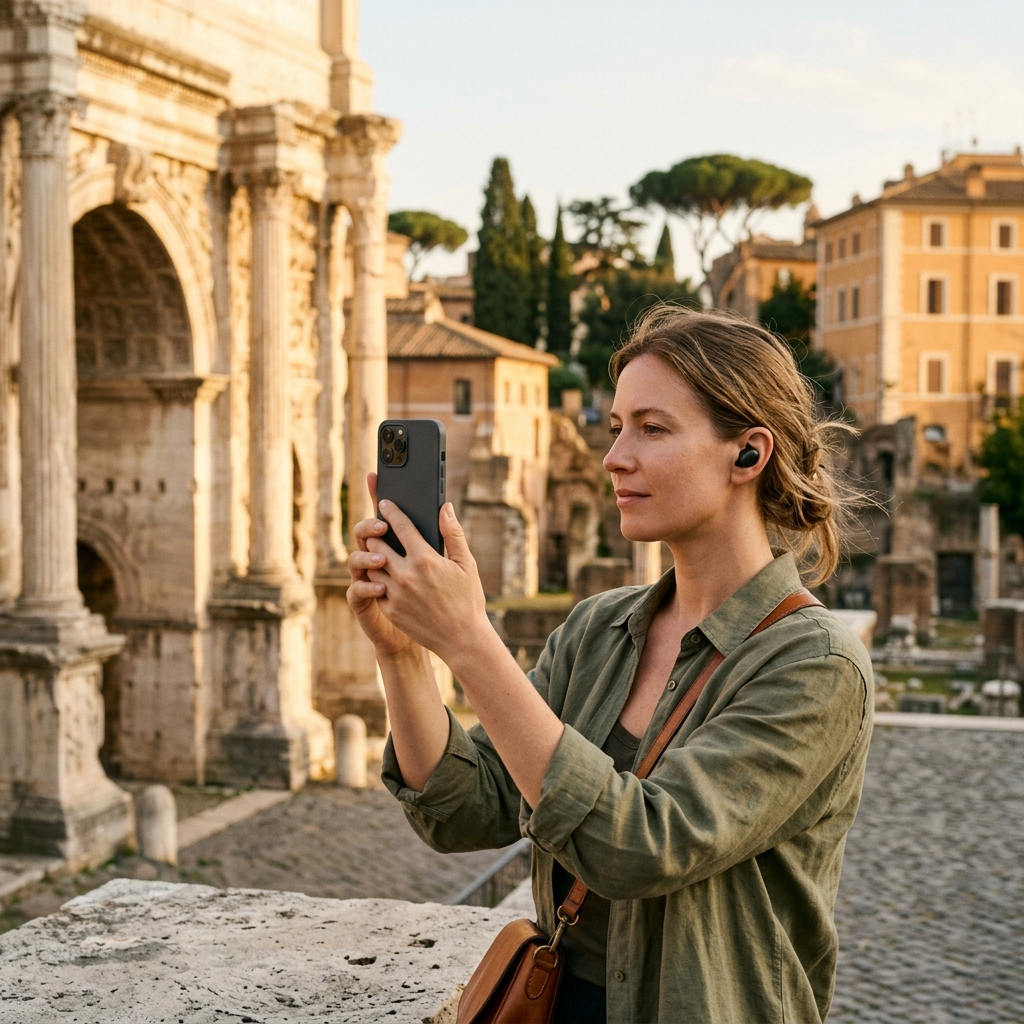
A central distinction between conversational bots and a dedicated app like Aitour is visual identification. With the AI Landmark Scanner, users take a photo of an unfamiliar landmark to identify it. The app matches the image to its catalog of points of interest without requiring typed queries.
The scanner also works with recorded media. Users can select an existing video from their device gallery, allowing the system to identify the landmark from the video thumbnail. Once matched, the app opens the corresponding point-of-interest page with photos and background information.
- Direct landmark identification: Photograph a site to open its catalog entry.
- Gallery video scanning: Identify landmarks using thumbnails from existing videos in your gallery.
- No typing required: Avoid manually describing unfamiliar sights in a chat prompt.
Key takeaway: Image recognition provides direct access to landmark details without manual searching.
Instant Voice Narration and Hands-Free Walking Tours
While chatbots deliver text itineraries, they do not provide automated voice narration. Aitour addresses this with audio features integrated into place listings and dedicated routes. Each point-of-interest entry includes a "Listen" option that uses text-to-speech to read place descriptions aloud.
For structured exploration, the Live Tour Guide offers AI-powered, voice-guided walking tours designed for hands-free listening. Every user receives a free trial to test the feature on walking routes.
When users want additional details about a specific monument, the "Ask AI" feature answers follow-up questions directly from the place page without requiring a separate chat thread.
Key takeaway: Text-to-speech narration and guided tours deliver place details through audio, keeping navigation hands-free.
Interactive Navigation Versus Static Chat Recommendations
Chatbots typically return text lists of place names and addresses, requiring users to manually copy details into an external navigation app. A dedicated travel app keeps location data and navigation in one view.
Aitour integrates Google Maps marked with cataloged points of interest. Selecting a marker displays a quick preview along with the distance from your current location. The interface supports dark mode, location refreshing, and direct navigation links.
- Open the interactive map to view nearby cataloged points of interest.
- Switch between grid and list views, or run a full-text search across names, categories, and descriptions.
- Select a marker to check distance, review photos, listen to audio descriptions, or launch navigation.
Key takeaway: Built-in maps display location markers, distance, and place previews in a single interface.
Personalized Trip Planning and Offline Usability
Audio guides are most effective when paired with structured itineraries. Rather than scrolling through saved text messages, Aitour users organize locations directly within the app.
Travelers can save places to favorites, create named trips, and reorder stops with drag-and-drop controls. For areas with limited connectivity, Aitour works offline, allowing users to review saved trip details without active cellular service.
Key takeaway: Saved collections, custom trip ordering, and offline access keep travel plans organized in one place.
How to Switch to an Audio-First Travel Workflow
Transitioning from a text chatbot to an audio-oriented travel app requires only a few clear steps:
- Build an itinerary: Browse the catalog or interactive map, save key points of interest, and organize them into a named trip.
- Scan unknown sights: Photograph unfamiliar landmarks or select video thumbnails to view their catalog profiles.
- Use audio playback: Connect headphones and select "Listen" on place pages, or start a Live Tour Guide walking tour.
- Ask follow-up questions: Use the "Ask AI" prompt on any place profile to clarify historical or practical details.
For travelers seeking audio-guided exploration without constant screen interaction, Aitour provides landmark identification, map navigation, and spoken guides in a single application.
Frequently Asked Questions
Chatbots rely on text messaging, which requires frequent reading and typing while walking. Audio guide apps provide text-to-speech narration, landmark scanning, and integrated map navigation in a single tool.
Aitour includes an AI Landmark Scanner that matches photos or video thumbnails against its catalog of points of interest to locate the corresponding place profile.
Yes. Aitour includes a Live Tour Guide feature that provides voice-guided walking tours powered by AI, allowing users to listen while walking.
Yes. Aitour includes offline support so travelers can access place details and review saved trips when cellular data is unavailable.