Free AI Travel Tech Tools to Navigate Unfamiliar Cities With Confidence

Navigating an unfamiliar city no longer requires balancing guidebooks, map tabs, and fixed tour schedules. Free AI travel tools, including mobile apps like Aitour: AI Travel Guide, allow travelers to identify unknown landmarks with a phone camera, listen to audio descriptions, and organize custom walking routes on an interactive map.
The Friction of Exploring Unfamiliar Urban Environments
Arriving in a new city often presents immediate hurdles. Travelers encounter historic monuments, neighborhood squares, and distinctive architecture without visible signage or background information. Learning about each site typically requires typing descriptions into search engines, cross-referencing conflicting articles, and switching between navigation and notes.
This disjointed process interrupts exploration. Group tours provide helpful context, but they adhere to rigid timetables, charge upfront fees, and proceed at a set pace. Mobile AI tools address these limitations by serving as on-demand guides that adapt to personal schedules and visual surroundings.
Key takeaway: AI tools consolidate discovery, historical context, and itinerary planning into a single mobile interface.
Visual Identification: Decoding Architecture and Sights in Real Time
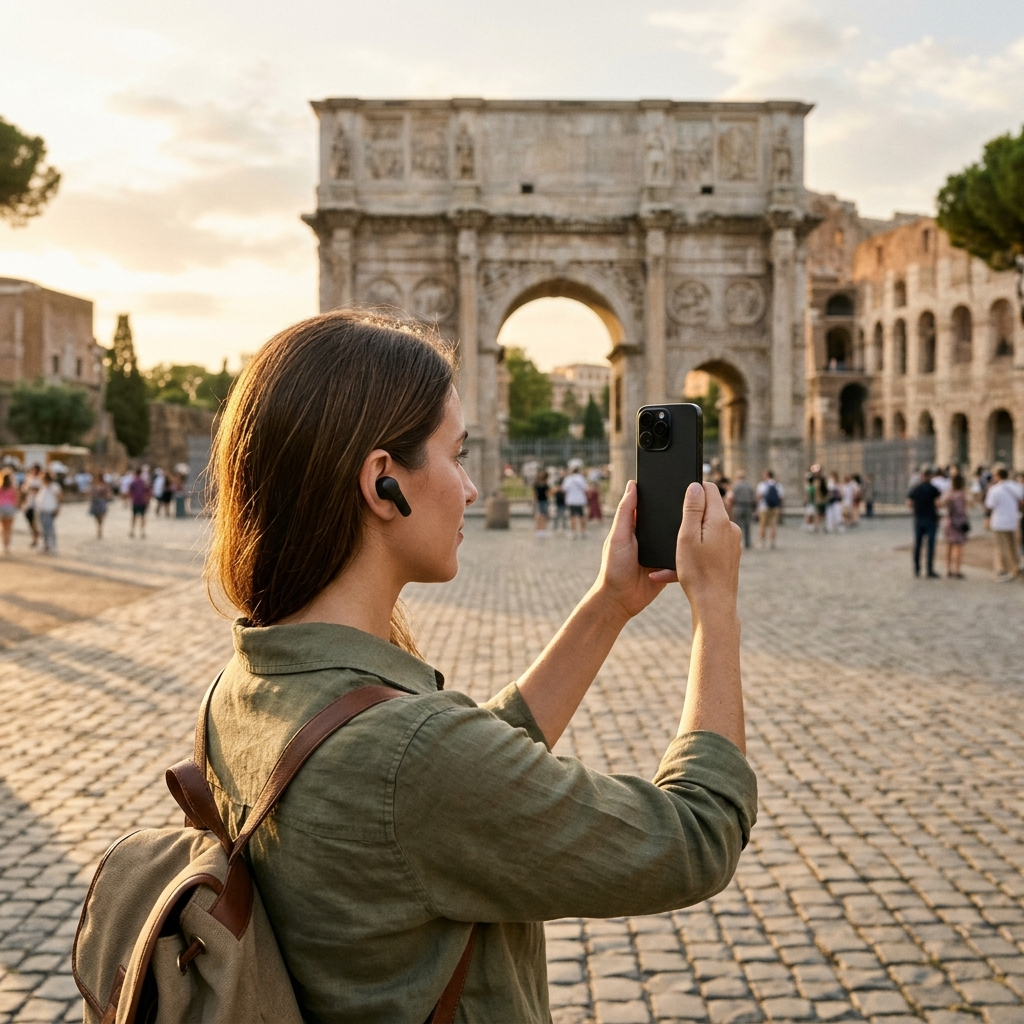
Computer vision offers a straightforward way to identify points of interest. Instead of guessing the spelling of names or describing a statue in a search box, travelers can capture an image of a structure for instant recognition.
Aitour's AI Landmark Scanner supports two capture methods:
- Photo scanning: Take a photo of an arch, cathedral facade, or public monument to match the image against a catalog of points of interest.
- Video thumbnail scanning: Select a recorded video clip from your device gallery to identify landmarks directly from the thumbnail.
Once matched, the app opens place pages containing factual histories and descriptions, reducing guesswork when exploring historic districts.
Key takeaway: Visual AI matches physical landmarks to verified catalog listings, bypassing manual search queries.
Hands-Free Exploration With Voice-Guided Audio Tours
Looking down at a screen while walking through unfamiliar streets limits situational awareness. Audio narration offers a safer, more attentive way to learn about sights in real time.
Aitour provides two audio options:
- Point-of-interest text-to-speech: On any place page, tap the listen button to hear the description read aloud while viewing the site.
- Live AI tour guide: For longer walks, the app offers voice-guided walking tours. Travelers can keep their devices stowed and listen to contextual narration between stops.
Every user receives a free trial to test the voice-guided tour experience before purchasing additional access.
Key takeaway: Text-to-speech and AI narration deliver architectural and historical details while keeping your attention on your surroundings.
Interactive Mapping and Dynamic Route Management
Efficient city navigation requires clear spatial planning. Unorganized recommendations often result in crisscrossing transit routes. Integrating points of interest directly into map layers helps prevent unnecessary travel.
Aitour's interactive Google Maps interface displays a user's location alongside nearby catalog markers. Selecting a marker opens a preview card showing the destination name, category thumbnail, and distance from your current position. The map also includes a dark mode setting to assist with visibility and device battery life.
For structured daily planning, users can save locations to personal collections, build named trip itineraries, and reorder stops using drag-and-drop tools. If schedules shift, adjusting the route order takes only a few seconds.
Key takeaway: Combining visual map markers with drag-and-drop trip tools ensures walking routes remain organized and easy to adjust.
Conversational Inquiries and On-Demand Historical Context
Pre-recorded audio guides follow fixed scripts that cannot answer spontaneous questions. AI assistants introduce direct, interactive inquiry to self-guided tours.
Within Aitour, travelers can select the Ask AI feature on any point-of-interest page to ask specific follow-up questions about a site's background, architectural style, or history. The assistant provides answers drawn directly from the context of the selected location.
Because reliable cellular data is not guaranteed in every transit station or historic corridor, Aitour also supports offline use, allowing travelers to continue exploring without an active data connection.
Key takeaway: Interactive AI prompts provide specific details that expand beyond static catalog summaries.
A Checklist for Navigating New Cities Using AI Travel Tools
To get the most out of mobile AI tools during an urban trip, complete these preparation steps before setting out:
- Confirm offline access: Save your planned destinations and walking lists so place details remain viewable without cellular roaming.
- Build a cohesive itinerary: Add 3 to 5 nearby stops to a named trip using drag-and-drop ordering to map an efficient route.
- Use single-ear audio: Listen to voice tours using one earphone to remain aware of local traffic and surroundings.
- Scan recorded video: If crowded streets prevent capturing a still photo, record a short video clip and scan the thumbnail from your gallery later.
- Review walking distances: Check the distance indicators on point-of-interest cards to estimate transit times between destinations accurately.
Navigating the Modern City With Precision
Urban exploration is most rewarding when travelers can focus on their surroundings rather than logistics. Mobile AI tools eliminate the need for paper maps, browser tabs, and rigid group itineraries. By combining camera identification, voice-guided audio walking tours, and direct route planning, Aitour: AI Travel Guide helps travelers explore unfamiliar cities independently and efficiently.
Frequently Asked Questions
The landmark scanner matches structural shapes and architectural features from a photo or gallery video thumbnail against an indexed catalog of points of interest.
Yes. Aitour includes offline support, allowing travelers to browse saved places and read catalog descriptions without an active internet connection.
AI voice-guided tours allow travelers to explore at their own pace, pause whenever needed, and use interactive features like Ask AI to learn specific historical details on demand.